.svg?dpl=dpl_9d6MXA7wPNSy777vZctNMsV1hpxR)
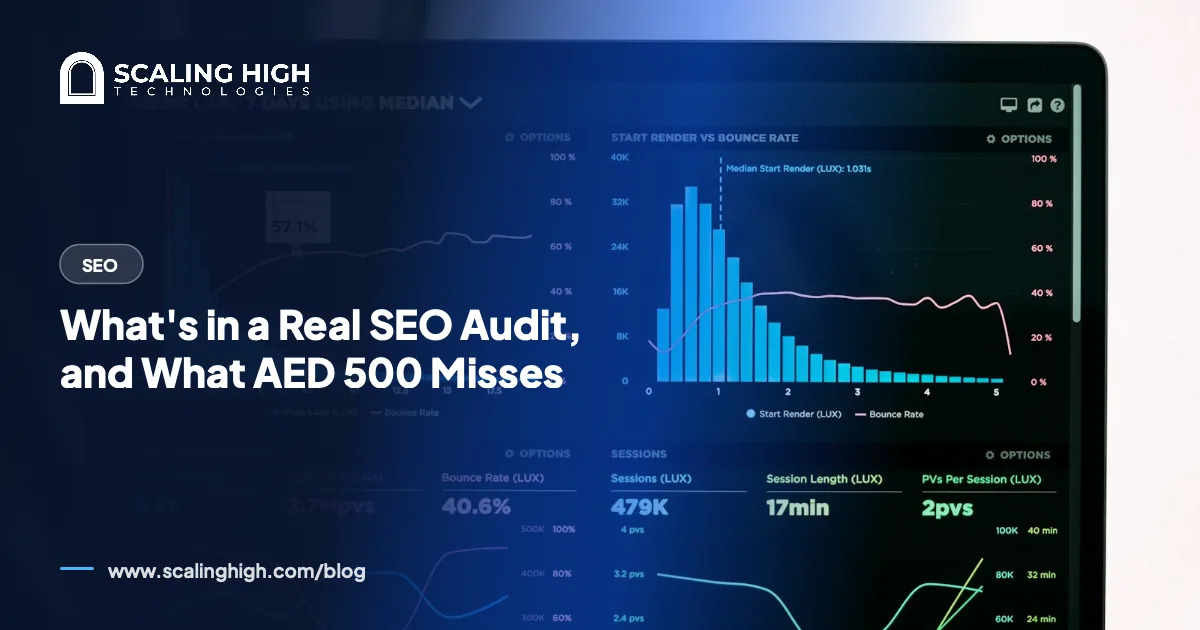
Type your website into most agency sites and a free SEO audit lands in your inbox before you have finished making tea. It runs to 40 pages, flags 900 issues, gives you a score out of 100, and tells you almost nothing. A real audit of a site under 100 pages takes between 8 and 20 hours of a specialist's time, and mid-market sites take 20 to 60. That gap is the whole story. This article covers what a real SEO audit actually checks, what the cheap version never touches, and the four questions that tell you which one you have been handed.
What an SEO Audit Is Actually For
An audit is a diagnosis. It answers one question: why is this website not getting the traffic and enquiries it should, and what is the shortest path to fixing that?
That framing matters, because it rules out most of what gets sold as an audit. A list of problems is not a diagnosis. A doctor who hands you a printout of every abnormal reading in your blood work without telling you which ones matter has not diagnosed anything. They have given you data and left you to panic.
The value in an audit is the judgement, not the detection. Finding 400 crawl errors is easy and free. Knowing that 380 of them are on pages nobody visits, that 12 are worth fixing this month, and that 8 of them explain why your main service page has never ranked, is the part that takes years to learn.
The Three Things Sold as SEO Audits
They are not the same product, and the price gap is not a rip-off. It reflects a real difference in what happens.
- The free automated scan. A crawler runs across your site and exports what it finds. Broken links, missing meta descriptions, slow pages, duplicate titles. Genuinely useful as a starting point, especially for a small brochure site. It has no idea what your business does, who your customers are, or which pages make you money. Cost: nothing to about Dhs 450 a month if it comes attached to a tool subscription.
- The cheap PDF audit. The same automated export, reformatted, with an agency logo on the cover and a page of generic recommendations at the back. Note what is missing: nobody read it. The problem is not that a tool was used, it is that no human ever looked at the output and decided what mattered. Improve page speed. Add more content. Build more backlinks. If the advice would apply equally to a law firm, a logistics company and a bakery, it is a template. Typically Dhs 300 to Dhs 900 in this market, and the reason it is cheap is that nobody spent time on it.
- The manual audit. A person opens your Search Console, crawls the site, reads your actual pages, looks at what your competitors are doing differently, and writes a prioritised plan tied to your business. Internationally this sits between roughly USD 1,500 and USD 5,000 for a small business site, more for e-commerce or multi-location. In the UAE, expect Dhs 4,000 upwards for genuine depth.
We offer a free audit too, so it is fair to say exactly what ours is. We run the automated scan, the same way everybody does, because tools are genuinely good at detection and there is no reason to do that part by hand. Then a person actually reads the output, throws out most of it, looks at your site and your Search Console if you share access, and comes back with a short prioritised list of what we would fix first and what we would ignore. The tool finds things. The person decides which of them matter. That second half is the part most free audits skip, and it is the only part with any value in it. What you will not get free is the full diagnosis, because that takes days and nobody gives that away.
What a Real Audit Actually Checks
Five blocks. A thorough audit covers all five, and the last two are where cheap audits stop entirely.
1. Crawl, render and index
Can search engines find your pages, read them, and are they choosing to index them? This means the Search Console Pages report page by page, robots.txt, sitemap accuracy, canonical tags, redirect chains, duplicate URLs, and whether JavaScript is hiding content from crawlers. It also now means checking whether GPTBot, ClaudeBot and PerplexityBot can reach you at all, because a lot of sites block them by accident through a security plugin.
2. Performance and experience
Core Web Vitals from real user field data rather than a lab score, measured on mobile first. Largest contentful paint, interaction to next paint and cumulative layout shift, with the specific scripts or components causing each failure identified by name. A finding that says improve your INP is not a finding. A finding that says your chat widget adds 340ms of main thread blocking on every page is.
3. On-page and content
Not just whether title tags exist, but whether each page targets a query anyone actually searches, and whether the page answers the intent behind it. This is where cannibalisation gets caught, which is two or three of your own pages competing for the same term and none of them winning. It is also where thin pages get identified, meaning pages that exist because a template needed filling rather than because a customer needed answering.
4. Off-page and authority
Who links to you, whether those links are real, and where the gap sits between your profile and the competitors outranking you. A good audit names three or four link sources your competitors have that you could realistically get, rather than telling you to build more backlinks.
5. AI search readiness and business alignment
The newest block and the one most audits skip. Does your business appear when someone asks ChatGPT, Perplexity or Google AI Mode a question you should own? Is your structured data accurate and does it match what is visible on the page? Is your business information consistent across your site, your Google Business Profile and every directory that mentions you? And then the part that has nothing to do with SEO tools: do the pages you want to rank actually convert, is the enquiry form working, is conversion tracking installed, and is anyone measuring leads rather than traffic?
Ask for Search Console access to be part of the audit and treat a refusal as a red flag. Crawl tools guess at what people search for. Search Console tells you what people actually typed to reach you, which pages get impressions but no clicks, and which queries you rank on page two for. Half the quick wins in any audit come from that one data source, and no external tool can see it.
What the Cheap Version Never Checks
Everything a tool cannot measure automatically. Which is to say, everything that requires knowing your business.
- Search intent. Whether your page about a service matches what people expect to find when they search for it. A tool cannot read a page and tell you it answers the wrong question.
- Cannibalisation. Which of your own pages are fighting each other, and which one should win.
- Your Search Console data. Impressions, click-through rate by query, and the page two rankings that are two edits away from page one.
- Competitor gap analysis. Not a list of competitor keywords, but the specific structural reason they outrank you on the terms that matter.
- AI visibility. Whether you get named in AI answers, and whether the crawlers that feed those answers can even reach your site.
- Schema accuracy. A validator confirms your markup is syntactically valid. Only a person can confirm it describes what is actually on the page.
- Conversion. Whether the traffic you already have is being wasted by a broken form, a missing phone number on mobile, or a page that ranks well and persuades nobody.
- Prioritisation by revenue. The single most valuable thing in an audit, and the one thing no tool can produce.
Four Questions That Tell You If an Audit Is Real
Whether you are choosing a provider or reading something you have already paid for, these four answers separate analysis from output.
- What did you decide to ignore, and why? A real auditor has a list of things they found and deliberately set aside. If everything found made it into the report, nothing was judged.
- Why is this the order? Every recommendation should be ranked by impact against effort, and the auditor should be able to explain the reasoning for the top three without looking anything up.
- Which of these need a developer, and which can my team do? A useful audit separates the two, and names the template or component each technical fix belongs to so a developer can act without a discovery phase of their own.
- What does the first month of implementation look like? If the answer is vague, the audit was written to be delivered, not to be used.
Red Flags
- The report arrived within minutes of you submitting your URL.
- There is a score out of 100 on the cover and no explanation of what would change it.
- The recommendations would apply unchanged to any business in any industry.
- It lists hundreds of issues with no ranking, which is usually a way of justifying the fee by weight.
- It promises page one rankings or guaranteed results. Walk away from this one specifically. Nobody controls Google's results, and anyone claiming they do is either lying or planning to use tactics that will cost you later.
- It ignores AI search entirely, which in 2026 means it was written from a 2021 template.
The Part Nobody Warns You About
An audit is worth exactly nothing until somebody does the work in it. It is entirely possible to pay for a genuinely good audit, read it, agree with all of it, and change not one thing, because the report lands on a desk with no time and no budget attached to it.
So before you commission one, answer two questions. Who is going to implement this, and what is the budget for the fixes? If the honest answer to the first is nobody, the audit is a document, not an investment. Spend the money on doing three things properly instead of on discovering thirty.
Want to know what is actually wrong with your site?
Start with the free version. We will look at your site and your Search Console, then send you a short prioritised list of what we would fix first and what we would ignore, in plain English. No automated PDF, no score out of 100. If a full audit makes sense after that, we will tell you what it costs and what it covers. Ongoing SEO starts at AED 1,500 per month.
Book a Free SEO AuditThe uncomfortable truth about SEO audits is that the cheap ones are not bad value, they are no value. A free tool report is a free tool report, and it is useful for exactly what it is. What you should not do is pay a few hundred dirhams for the same export with a cover page, then conclude from the silence that followed that SEO does not work for your business. It usually did not work because nobody ever actually looked.